
Skip to content
 
Rework
  • What We Offer
  • Case Studies
  • Blog
  • Leadership
  • Contact Us
  • What We Offer
  • Case Studies
  • Blog
  • Leadership
  • Contact Us

Category: Uncategorized

From tools to processes

Over the past year I have had around 200 conversations with senior leaders at Finnish companies. Their thinking has shifted significantly. Not long ago, AI meant Copilot licenses and a handful of individual agents. Now it means redesigning entire processes and workflows.

The first model is about individual productivity: working more efficiently and freeing up time for other, often more valuable, work. A person gives a language model or an agent a task, and the AI carries it out. It saves time and often improves the quality of the result.

The second model changes how teams work and how the operating model is built. AI is no longer a tool on one person’s desk. Processes are designed from the start so that automation handles routine steps in the background, along with cognitively demanding tasks where AI outperforms people. Humans remain central to the process, but their role changes. Decisions, exceptions and accountability for the outcome stay with them.
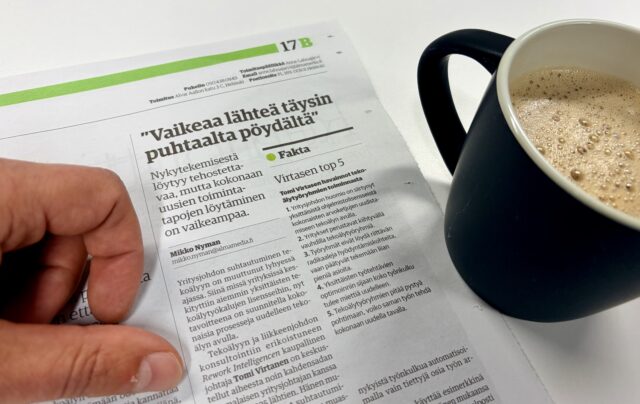
Tomi Virtanen, Kauppalehti Teknologia 7.10.2026
Tomi Virtanen, Rework Intelligence Oy, Kauppalehti 7.10.2026

Mindset ahead of practice

Thinking has already moved toward the second model, but day-to-day practice has not caught up. The need has been recognized and the shift is under way. In recent months, many organizations have set up internal AI task forces to find the best use cases in their own processes.

The clean-slate problem

The challenge for these task forces seems to be that few organizations can spot the most radical opportunities in their own work. They tend to identify bottlenecks in current ways of working and optimize existing processes, instead of figuring out from a clean slate how a desired outcome could be achieved with today’s tools.

Still, the journey toward AI-native process thinking has begun, and leadership sees the need clearly. It is already written into strategy, and the pressure comes from well-informed boards and from employees who have gotten to know AI in their personal lives as consumers.

Where Rework comes in

Alongside process reviews and redesign, we at Rework help clients identify the best use cases for applying AI. Sometimes that also means helping launch an internal AI task force or supporting a new AI role. We help, for example, with identifying candidate ideas from both internal input and data-based analysis of process inefficiencies, and turning them into prioritized action lists and business requirement specifications. More broadly, we help define the operating model needed to scale AI benefits and keep improving them, and we help set up the right measurement to secure long-term value.

Share this article

Link copied

Anyone who has ever had, or been, a kid in the back seat will recognize the question:

Are we there yet?

I’d like to think I was a reasonable kid. I wouldn’t start asking straight away after we left home, but would wait until we had been on the road long enough for the question to feel justified. By then, we had clearly made progress, but from the back seat it was surprisingly hard to tell how much of the journey was left. The questions could start. Are we there yet? What about now?

What does this have to do with AI and consulting productivity?

I think consulting has now been on this road long enough for the question to feel justified, too: have we actually arrived at the kind of productivity gains we have been told AI would bring?

In one sense, the answer is clearly yes. Generally available AI tools already let us do many parts of our jobs much faster than before. Research, drafting, analysis and presentation work are obvious examples.

But as a whole, I don’t know. Many individual tasks are already much faster, but it is less clear what that has added up to at the level of the job itself. Didn’t we only just pass the gas station that was supposed to be somewhere around the midpoint? What will it look like when we are there? What would actually have had to change along the way for consulting productivity as a whole to reach something like 5× today’s level?

I increasingly think the answer has less to do with making individual tasks faster, and more to do with how much of a consulting engagement still has to be continuously carried by a person.

What if “AI does the routine work” is the wrong starting point?

This is a question we have been forced to think about while building Rethink, our AI product for management consulting.

Our initial instinct was fairly conventional: find recurring work with limited need for judgment, automate it, and leave the difficult parts to the consultant.

AI does the routine work. Humans do the hard thinking.

There is nothing obviously wrong with that division. But I am no longer convinced it gets you very far towards 5×.

AI would have to do more than help with the work while the consultant is there. It would have to carry enough of the engagement that useful work can continue while the consultant’s attention is somewhere else.

In our case, that would mean Rethink becoming the best-informed member of the team on where the inquiry stands and where it is going. It should know what has changed, what remains unresolved, what the evidence now suggests, and what is worth asking next. And if it can also do the routine work of asking those questions, all the better.

That is a very different ambition from automating routine work. The goal is not for AI to make the final judgments or replace the consultant, but for the machine to take responsibility for maintaining the state of the inquiry.

Software development offers an interesting comparison

Something like this shift is already visible in software development.

Early AI coding tools mostly made developers faster at things they were already doing. Complete this function. Explain that code. Write a test. Generate some boilerplate.

Certainly useful, and even more so as AI has learned to write more complex and difficult code over time. But the human still has to be there for the work to continue.

The more interesting shift is that an agent can now be given a larger piece of work and keep going. It can inspect the codebase, make changes, run tests, see what failed, revise the implementation and continue, while the developer’s attention is somewhere else.

Software development does, of course, give AI some important advantages. The thing being worked on is machine-readable. The agent can act on it directly. Tests tell it quite quickly whether many of its actions worked, and mistakes can often be reversed.

That means the agent can stay inside a loop of observe, act, check, correct without requiring a person to hold the loop together.

In many other AI workflows, the person is still doing exactly that. They gather the information, give it to the model, check the output, take the next action somewhere else, observe what happened and come back.

The AI may be doing sophisticated work in the middle, but the person is still keeping the process alive.

What would this look like in consulting?

Imagine a fairly ordinary engagement. There have been a dozen stakeholder interviews, several versions of a process map, a growing list of hypotheses, a data request that is still only partly answered, and a steering meeting next week.

The familiar use of AI is to make each piece faster. Summarize the interviews. Draft the process map. Analyze the data. Prepare the slides.

In the more ambitious version, as new interviews come in, the system would update its understanding of how the process actually works. It would notice that three people describe the same handover differently, that a new data point weakens one of the working hypotheses, and that an apparently minor exception may explain a problem seen elsewhere. It would keep track of what is still unknown and which questions are now worth asking.

When the latest dataset arrives, the work would not begin with somebody remembering why it was requested. The system would already know which questions the data was supposed to answer, run the relevant analysis, connect the findings back to the inquiry and identify what changed as a result.

And before the steering meeting, the consultant would not ask AI to “prepare a deck.” The more useful starting point would be that the system already knows what has happened since the previous meeting, which conclusions have become stronger or weaker, where the client still disagrees, and which decisions now need human attention.

The consultant would still decide what they believe. They would still challenge the client, read the room, make trade-offs and take responsibility for the recommendation.

But they would be returning to an inquiry that had remained alive and progressed while they were doing something else. That would allow the consultant’s attention to move between more engagements without each one effectively pausing in their absence.

There is an important condition to all of this, though. If the consultant has to go back through every interview, dataset and intermediate conclusion to check what the system has done, not much has been gained. For this kind of delegation to work, it has to be possible to see where conclusions came from, what changed them and where uncertainty remains, without doing the work all over again.

That, to me, is a much more plausible picture of 5× productivity than making every individual consulting task five times faster.

We may not be quite there yet, but we’re getting closer.

Share this article

Link copied

AI is making it faster to turn ideas into solutions. But faster execution does not tell us what ideas are worth building, whether the underlying work should change first, whether the organisation can absorb the change, or whether anything improves.

As execution accelerates, the constraint moves elsewhere: to prioritisation, decision-making, work redesign, adoption and value realisation. At Rework, we use the term AI Value Operations (AI Value Ops) to describe the operating layer. An AI software factory can accelerate delivery, but not repair broken Value Operations. It will expose them.

The Real Constraint Is Outside Execution

A decade ago, I worked with mobile garages and mobile factories. The promise was start-up speed with enterprise scale: a small core team close to the client, reusable baselines, clear guardrails and offshore capacity ready to build once direction was clear.

The model worked when the team had knowledge, trust and autonomy. Reference architectures, reusable components, delivery practices and agreed boundaries created a baseline within which people could make sensible decisions.

But development capacity was rarely the real bottleneck. I remember one project where the development team was ready to continue, but business wasn’t able to agree on the open design questions. Nothing was technically blocked.

Stand-ups and decision logs were not status rituals. At their best, they removed decision obstacles and forced open questions to closure and kept the pace. Without that discipline, the factory had capacity but the work did not flow. That lesson feels current again.

Then, the capacity was in offshore teams and global delivery factories. Now it is increasingly in agentic development and agents themselves. Faster coding, testing and production are real. But weak Value Operations means a faster factory simply reaches the bottleneck sooner.

AI Moves the Hard Work to the Edges

Traditional delivery relied on people to carry work through the system. That flow was slow and often hand-off heavy, but people also absorbed ambiguity along the way: missing details, architectural fit, edge cases and unresolved assumptions.

In increasingly agentic flow, agents can take structured intent, decompose it, generate implementation, create tests and prepare something close to finished. As production accelerates, the human role shifts.

People move increasingly to the edges: at the front, deciding what deserves to enter; at the back, judging what comes out; and around the flow, defining guardrails, ownership and value measures.

AI is not eliminating constraints. It is relocating them from engineering to management: from production capacity toward choosing the right change, closing decisions, redesigning work, driving adoption, and proving value.

AI Value Operations Is Not a Traditional PMO with an AI label

Value Operations is the operating system around execution. It connects intent, prioritisation, decision rights, work redesign, quality, adoption, maintenance, feedback and value measurement.

Some of this is familiar from programme management, transformation offices and portfolio governance. AI does not make those disciplines obsolete. But AI Value Operations should not become a traditional PMO with an AI label.

Value Operations should not create another control or approval layer. Its role is not to collect status updates or create another layer of approvals. It should help teams make better decisions while the work is happening. It should identify overlapping initiatives, challenge assumptions, and compare whether the right answer is to build, buy, adapt an existing solution, or solve the problem in another way.

AI should also support the Value Operations work itself. Benchmarking, initial analysis, requirements definition and process performance assessments should not always require another manual round of presentations and spreadsheets.

Five Disciplines That Keep Fast Execution Connected to Value

1. What is the value intent?

What outcome should improve, for whom, and who owns it? A weak idea does not become stronger because it can be implemented quickly.

2. How will decisions flow?

Who can approve, stop or scale the initiative? If decisions remain trapped between functions and steering groups, faster production will only bring us to the next unresolved question sooner.

3. How should the work change?

AI should not simply automate the current process. Which steps could disappear? Which handovers are unnecessary? Where is the actual bottleneck? Process data may show that the real problem sits between teams rather than in the task everyone first wanted to automate.

4. How will adoption happen?

Deployment is not adoption. Release notes are not change management. Value appears when behaviour changes, a process runs differently, a decision improves, a cost disappears or a risk is reduced.

5. Who will own this and how will value be proven?

Faster production creates more assets, dependencies, controls and things to maintain. Who will monitor, improve, secure, fund and eventually retire the solution? Did the bottleneck disappear or move elsewhere?

The Same Constraint Applies Beyond Software

Software factories make this shift particularly visible. But the same constraint is emerging anywhere AI increases the number of technically possible ways to change how work gets done.

Finance, procurement, customer service and enterprise-system renewal all offer multiple ways to improve work: standardise the ERP, automate a rule, use an existing capability, deploy an agent, redesign the process or combine several interventions. The hard part is selecting what addresses the real constraint and proving what changed.

That is why the unit of management should not be the AI use case alone. It should be the business change around it: the decision, process, behaviour or outcome that needs to improve.

Can We Improve as Fast as We Can Build?

We are gaining the ability to create AI solutions faster than we are improving our ability to choose, absorb and evaluate them.

Advantage comes from making better choices, stopping initiatives that do not bring value, redesigning work and turning delivery speed into measurable improvement. That is the role of Value Operations. The real competition is no longer who can build fastest, but who can improve fastest.

Share this article

Link copied

AI-native process redesign means rethinking how work gets done when people, AI and systems share responsibility for the outcome. It goes beyond automating existing tasks to reconsider the steps, roles, decisions and interactions the work requires.

Process mapping has long been a reliable tool for improving processes. You observe the work, interview the people involved, and document the steps, systems, handovers and bottlenecks. You find where time is lost, where quality suffers and where the experience could be better.

That still matters. But in AI-native redesign, it is not always enough, because process work starts from the current process. It assumes the work will remain recognisable, and aims to make it faster, clearer or more consistent. That is valuable when the goal is improvement, but not when the goal is redesign.

So instead of asking only “How does this process work today?”, we also need to ask “How would we achieve the desired outcome if we started today?” That is a harder question for everyone involved.

Why redesign is difficult from inside the current process

It is hard for the people doing the work, because they know the current reality deeply: the exceptions, the informal fixes, the difficult customers, the missing data, the unhelpful system screens and the small workarounds that keep the process alive. That knowledge is essential, but it can also make radical redesign difficult. When asked how their work should change, people often answer from inside the current constraints. They may not know what AI can already do, or which parts of the work could be moved, removed or reshaped. They may also have good reason to be cautious. If the discussion sounds like a cost-cutting exercise, they will defend the current process rather than imagine a new one.

It is hard for consultants too. Traditional methods reward careful listening, structured analysis and incremental recommendations: map the current state, find the pain points, propose improvements. Often the organisation already knows what needs to be done, and the consultant is there to confirm it is on the right path and package the ideas into a coherent plan. That can still produce value, but it may miss the bigger shift. In AI-native redesign, the consultant cannot only ask what should change. They also need to bring new possibilities into the room, not as technology hype or a list of tools, but as concrete choices about how work, interaction, engagement and transaction could operate differently.

What AI-native process redesign changes

AI changes more than the sequence of activities inside a process. It can change the whole system of interaction around the work. In many traditional processes, people search for information, move it between systems, prepare decisions and complete transactions step by step, interacting with the organisation through forms, emails, portals, meetings, tickets and handovers. AI makes it possible to rethink that model. The interaction can become more conversational, contextual and continuous. The system can ask for missing information, assemble context, prepare the next best action, surface evidence, assess confidence and trigger the right workflow before a person has to start from a blank page.

The real design question is not how to make the process faster. It is how work is distributed when people, AI and systems share it. Does the employee fill in a form, or does the system carry them to the outcome? Does the expert produce every answer, or stand over the ones AI produces? Is the work standardised for control, or personalised because AI makes personalisation scalable? Do people start every transaction, or does the system start the ones it can see coming?

Each question reframes a default as a choice. Together they describe a shift from designing steps to designing judgement.

Designing for judgement, accountability and trust

Current-state mapping alone will not answer these. They require imagination, but not fantasy. The work still needs controls, governance, trust and clear accountability, and the new model still has to be economically viable. In many cases the answer is not full automation but a better division of labour between people, AI and systems. To scale the benefits, it often means rethinking the underlying architecture as well and upfront investments for wider portfolio of use cases.

That is why AI-native process work should not be reduced to automation opportunity mapping. An automation opportunity is usually a task. Radical redesign is about the shape of the work. A company can automate individual steps and still keep the same slow, fragmented process. It can remove manual effort and still leave decision-making unclear. It can introduce AI tools and still fail to change roles, measures, accountability or the way people actually engage with the organisation.

Leadership should therefore be careful about asking only “Where can we use AI?” A better question is: “What work should still exist in this form? How should interaction, engagement and transaction change? Where are human judgement and accountability non-negotiable?” That is a more demanding conversation, and it is where the strategic value of AI becomes visible.

How Rework approaches process redesign

At Rework, we help companies look at AI opportunities on three levels, optimisation, radical optimisation and redesign, depending on their objectives. Sometimes the right answer is to make the current process faster or lighter. Sometimes it is to rethink a larger part of the flow. And sometimes the real value comes from redesigning the work itself: the roles, decision rights, interaction model, service experience and transaction logic around it.

We will soon share examples from client work where AI has shifted the conversation from automation to operating model redesign. If you want to understand which level your organisation should be aiming for, we would be happy to talk.

Share this article

Link copied
  • Home
  • Our Approach
  • What We Offer
  • Leadership
  • Contact Us